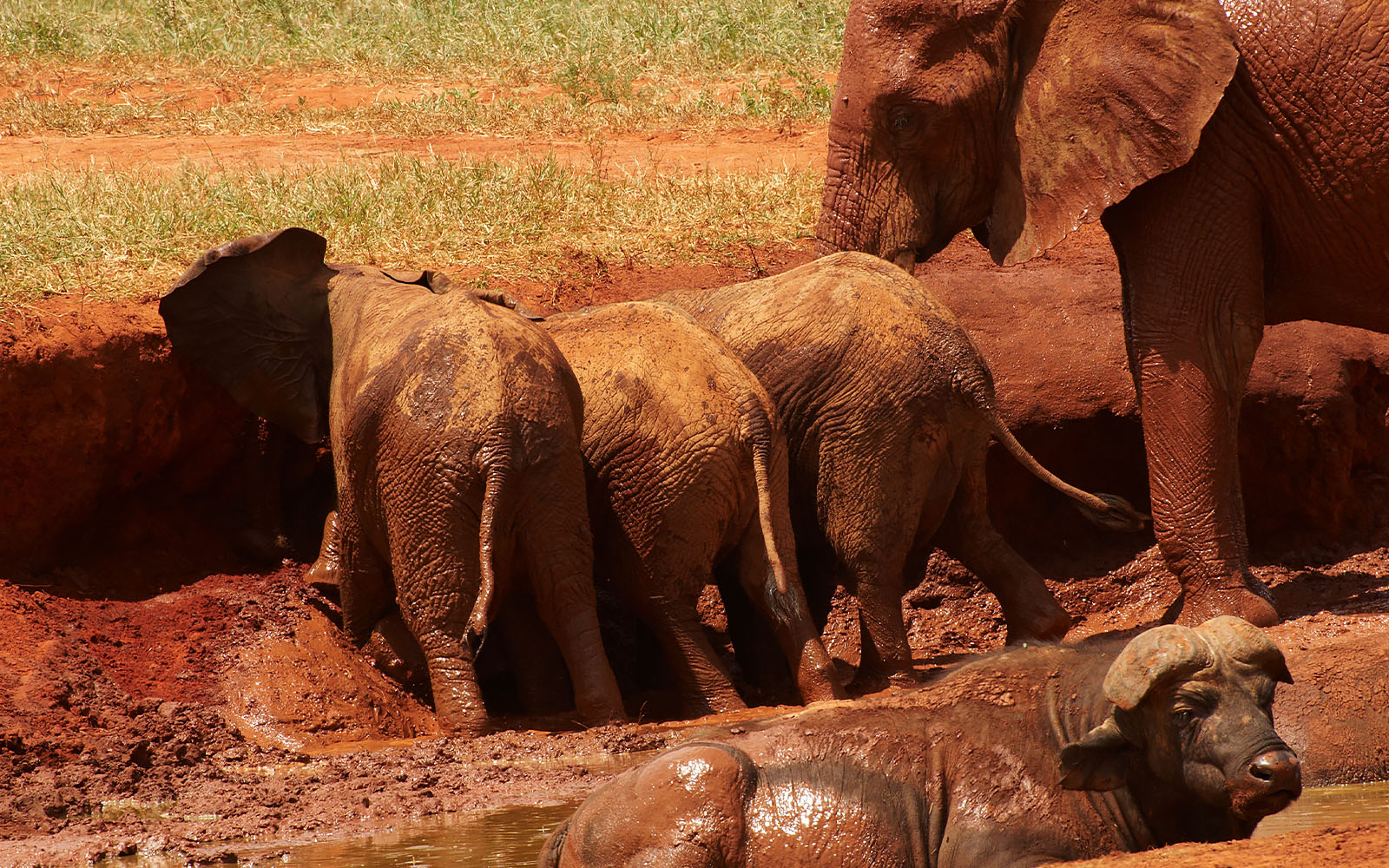
The red elephants of Tsavo East line up at a muddy waterhole, offering me three perfectly visible tails—and not a single cooperative face.
The red elephants of Tsavo East created one of the most amusing wildlife scenes I photographed during my journey through Kenya. Three young elephants stood together at the edge of a muddy waterhole, all facing in exactly the wrong direction for a conventional wildlife portrait. Instead of expressive eyes, raised trunks and perfectly framed faces, I was presented with three backs, three tails and absolutely no interest in cooperating with the photographer.
At first, I waited for at least one of them to turn around. None did. They remained close together, concentrating entirely on the mud and water in front of them. An adult elephant stood nearby, while a Cape buffalo rested in the foreground, apparently accepting the busy waterhole as a shared neighbourhood. The longer I watched, the clearer it became that the composition was already complete. It was not the photograph I had expected, but it was a far more honest—and much funnier—picture of life in the African bush.
The famous reddish appearance of the red elephants of Tsavo East does not come from a separate species or a natural difference in their skin colour. African savanna elephants are normally grey, but in Tsavo they regularly cover themselves with the park’s distinctive red soil and mud. The fine earth settles into every fold and wrinkle of their skin, gradually giving them the warm, rusty colour for which the elephants of this region are known.
Mud and dust are also practical rather than decorative. By throwing soil over their bodies and wallowing in wet ground, elephants can cool themselves and create a protective layer against strong sunlight and irritating insects. In Tsavo East, this natural behaviour transforms them visually, making the elephants appear almost as though they have been painted to match the landscape. Their colour connects them perfectly with the red roads, dry plains and earth surrounding the waterholes.
Watching elephants at a waterhole gave me time to notice details that are easily missed during a brief encounter from a safari vehicle. The youngest animals stayed close together, copying one another’s movements and remaining within reach of the adult. Their apparently casual arrangement reflected the importance of family bonds within an elephant herd. Even while drinking, bathing or playing in the mud, young elephants rarely move far from the protection and guidance of older members of the group.
The Cape buffalo in the foreground added another layer to the scene. It was covered in the same wet mud, sharing the limited water without disturbing the elephants gathered behind it. Waterholes in Tsavo East function like busy meeting places, attracting different species that may otherwise remain separated across the vast landscape. For a wildlife photographer, they offer the opportunity to observe not only individual animals but also the quiet negotiations, distances and routines that allow many species to use the same essential resource.
What I particularly like about this photograph is its refusal to behave like a classic safari image. Wildlife does not pose, check the light or turn towards the camera on request. The red elephants of Tsavo East simply continued with their day, and I had to work with the view they offered me. Their three tails became the main characters, while their missing faces turned an ordinary visit to the waterhole into a photograph with its own sense of humour.
This image reminds me that successful wildlife photography is not always about capturing the most powerful stare or the most dramatic movement. Sometimes it is about recognising an unexpected composition before the moment disappears. I arrived hoping for a majestic portrait of elephants and returned with three perfectly aligned backsides, one muddy buffalo and a story I could never have planned.
In the end, the elephants may have ignored me completely, but they still gave me exactly what I needed: an authentic moment from Tsavo East and a photograph that proves even the wrong end of the subject can tell the right story.
- Date
- 2026-01-01