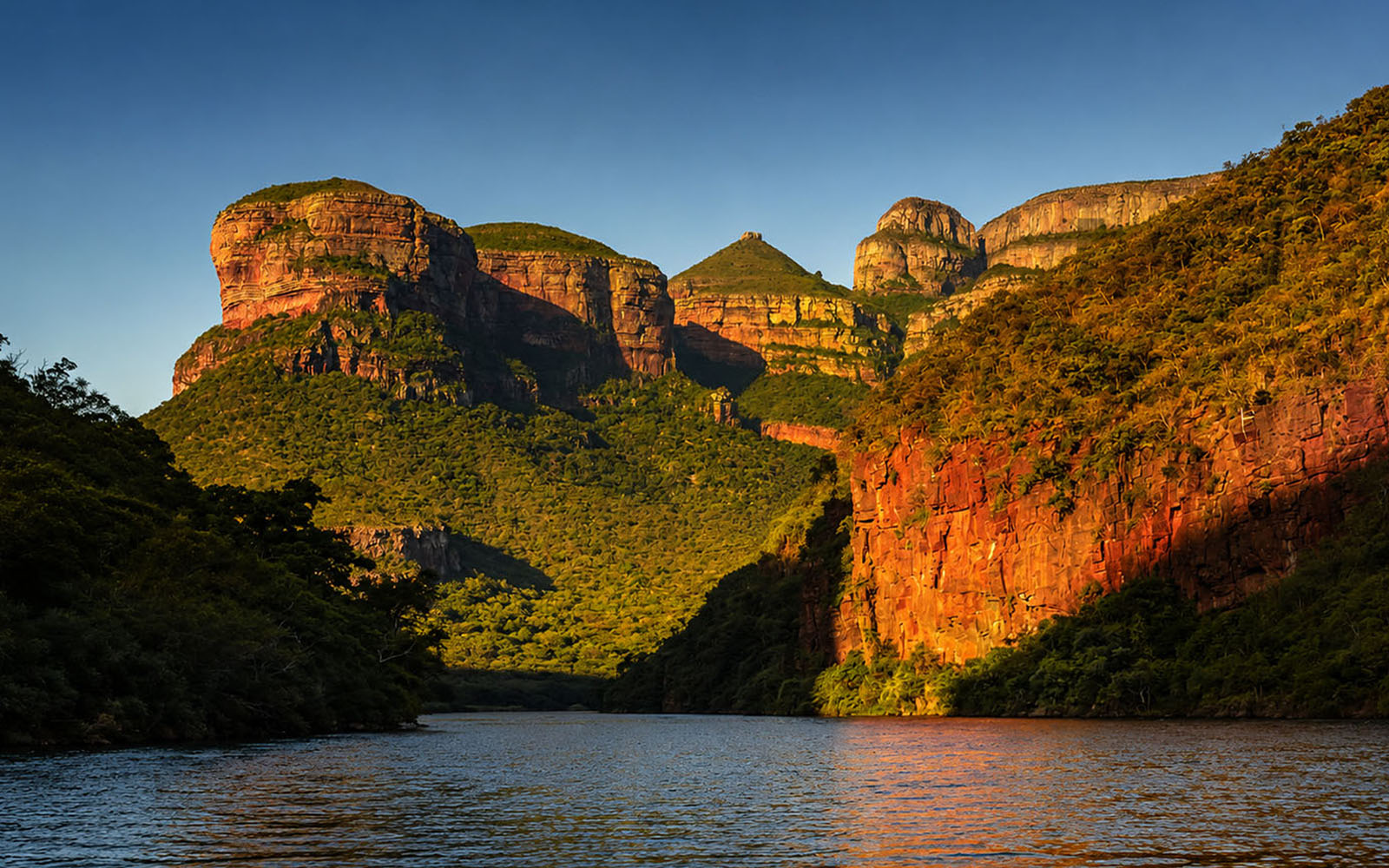
A Blyde River Canyon boat cruise takes me beneath sunlit cliffs and through the winding waters of Blydepoort Dam in Mpumalanga, South Africa.
This Blyde River Canyon boat cruise gave me a completely different perspective on one of South Africa’s most spectacular natural landscapes. Instead of looking down from the famous viewpoints along the Panorama Route, I found myself at water level, surrounded by the immense green slopes and sunlit rock walls of the canyon. From here, the landscape did not look like a distant panorama. It felt close, monumental and almost impossible to escape from—in the best possible way.
I photographed this scene from the waters of Blyderivierspoort Dam, also commonly known as Blydepoort Dam. The reservoir fills the lower section of Blyde River Canyon near Swadini and Hoedspruit in Mpumalanga. Its winding shape follows the natural course of the valley, disappearing between the mountains as if the river had deliberately chosen the most scenic route available. That impression gave this photograph its title: “The River Took the Scenic Route.”
From above, the water looks like a narrow blue line dividing the enormous green landscape. From the boat, however, it becomes the road itself. Every bend opens a new view, and the cliffs seem to rearrange themselves as the perspective changes. Mountains that appeared to stand next to each other suddenly separate, revealing hidden valleys, darker rock faces and additional layers of vegetation.
The warm light was one of the most important elements of this photograph. It reached the upper rock formations and the cliff on the right, turning their exposed surfaces into deep shades of orange, gold and red. At the same time, the lower vegetation and the left side of the canyon remained in shadow. That contrast created a natural frame and directed my attention toward the illuminated walls.
The light also reached the surface of the water, where it formed a warm reflection beneath the brightest section of the cliff. The water remained mostly blue, but the reflected rock added a subtle orange path across it. For me, this small area of colour connects the reservoir with the mountains and prevents the two parts of the landscape from feeling separate.
What impressed me most was the relationship between water, rock and vegetation. The cliffs reveal layers shaped over an immense period of time, while the dense subtropical foliage seems to occupy every available surface. Trees and shrubs climb the slopes, fill narrow spaces between the rocks and soften the edges of the canyon without diminishing its scale.
From this lower perspective, I could understand why Blyde River Canyon is often described as one of the world’s great green canyons. Its character does not come only from its depth or length. It comes from the way its mountains, forest and water exist together. The landscape feels dramatic, but it does not feel empty or lifeless.
During the Blyde River Canyon boat cruise, I was no longer photographing a view from outside. I was moving through the centre of it. The water carried me beneath the cliffs, allowing me to observe their height and structure from a position that the roadside viewpoints cannot provide. Looking upward at these formations made their scale much more immediate.
I composed the photograph so that the dark vegetation on the left and the illuminated cliff on the right would form two natural sides of the frame. The water creates an open foreground and leads the eye toward the mountains in the centre. Above them, the clear blue sky gives the composition space and prevents the enormous rock formations from making the image feel visually crowded.
There is also a quietness in this frame that I remember clearly. Despite the size and drama of the canyon, the water appears calm. The mountains remain completely still, while the changing sunlight slowly travels across their surfaces. The only visible movement comes from the slight texture of the reservoir and the gentle reflections on its surface.
The title “The River Took the Scenic Route” adds a little humour, but it also describes the geography surprisingly well. The water does not travel through an ordinary valley. It bends between enormous rock walls, green slopes and formations that look as though they were designed specifically to impress anyone passing beneath them. If a river could choose its surroundings, it would be difficult to imagine a more spectacular route.
This image complements my panoramic photograph taken from the Three Rondavels Viewpoint. From above, I saw the enormous structure of Blyde River Canyon and the way the water disappeared between its mountains. From below, I experienced the same place on a more personal scale. The cliffs were no longer distant elements of a panorama; they towered directly above the water on which I was travelling.
Photography often changes depending on where I stand. In this case, changing my position from the rim of the canyon to the surface of the reservoir transformed the entire story. The wide panorama became a journey, the distant river became my route, and the mountains became walls surrounding the frame.
This photograph preserves the moment when the late light reached the canyon and turned part of the rock face into a glowing wall above the water. It reminds me that even the most famous landscapes can reveal a completely different personality when viewed from another level. Sometimes the best way to understand a panorama is to stop looking at it from a distance and travel directly into it.- Date
- 2026-01-01