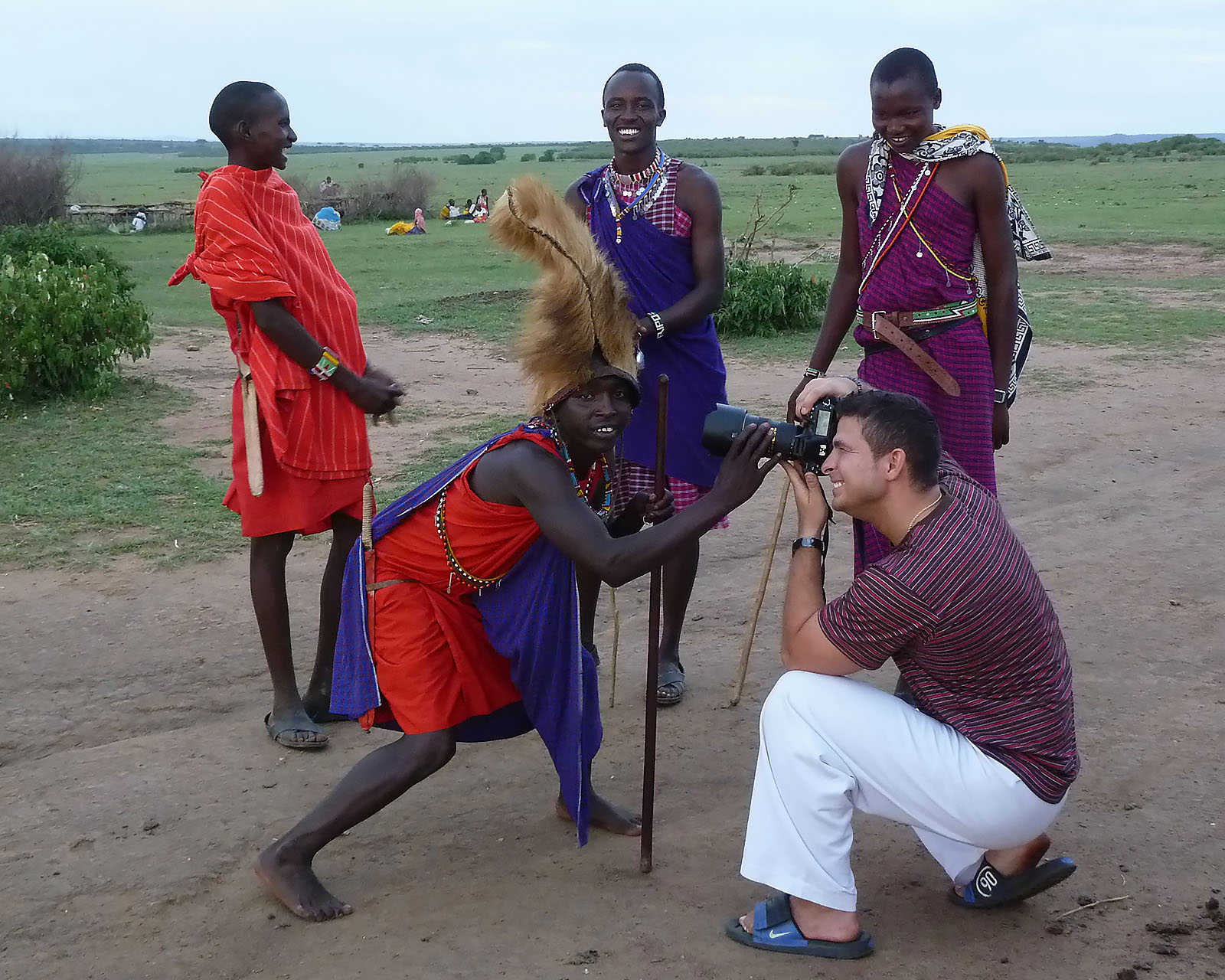
During a Maasai cultural encounter in Kenya, my camera gained a second operator, several advisers and a very amused audience.
This Maasai cultural encounter in Kenya gave me one of the funniest and most spontaneous photographs from my journey near Tsavo East National Park. I am usually the person standing safely behind the camera, choosing the frame and waiting for the right expression. This time, however, the usual roles became slightly confused. One of the Maasai men reached for the lens while I was still looking through the viewfinder, and for a moment it was difficult to decide who was actually taking the photograph.
The image was created during my visit to a Maasai village near Voi and Tsavo East. I had already spent some time photographing the people I met there, but the camera quickly became more than a tool for documenting the visit. It attracted curiosity, encouraged interaction and gave us a reason to communicate even when words were not enough. Instead of a formal portrait, I ended up in the middle of a playful photographic duel.
Looking at the picture now, I like the fact that nobody appears to be taking the situation too seriously. The men standing around us are smiling, while my temporary assistant—or perhaps my new photography director—holds the lens as if he has just decided that my composition requires immediate correction. I am still trying to look through the camera, but judging by the scene, I am no longer fully in charge.
That role reversal is exactly what makes this photograph memorable for me. During most of my travels, I observe people and places through the lens. I concentrate on light, movement and details, sometimes forgetting how unusual the camera itself may look from the other side. Here, the camera became part of the story. It was no longer an invisible object separating the photographer from the people in front of him. It became a shared point of interest and, for a few seconds, a small bridge between different experiences.
The traditional clothing and colourful beadwork worn by the Maasai men give the photograph a strong visual identity. Their red, blue and purple garments stand out against the open green landscape surrounding the village. However, what interests me most is not only the clothing or the location. It is the natural energy between everyone in the frame. The smiles, gestures and relaxed body language say much more about that moment than a carefully arranged portrait ever could.
A short visit cannot explain the full complexity of Maasai culture, traditions or contemporary life. I do not treat this photograph as a complete story about a community. For me, it records one personal encounter: a brief moment of humour, curiosity and mutual participation during my journey through Kenya. That distinction matters because travel photography should not only show how people look. At its best, it should preserve something about the atmosphere of meeting them.
This Maasai cultural encounter in Kenya also reminded me that some of the strongest travel photographs happen when the original plan disappears. I may have intended to photograph the men standing in front of me, but the situation changed as soon as someone reached for my camera. The photographer became part of the photograph, the subject became involved in creating it, and everyone around us reacted to the unexpected scene.
The title “Who’s Behind the Lens Now?” came naturally because the picture does not offer a simple answer. Technically, I am still looking through the viewfinder. In practice, the lens appears to have acquired a second operator, several advisers and an enthusiastic audience. It was probably the most overstaffed photography session of my journey—and certainly one of the most entertaining.
When I return to this image, I do not first remember camera settings or technical details. I remember the laughter and the feeling that, for a moment, the distance between visitor and host had disappeared. Photography created the encounter, but the people made it worth remembering. That is why this frame remains one of my favourite personal memories from Kenya: spontaneous, imperfect and full of character.- Date
- 2026-01-01