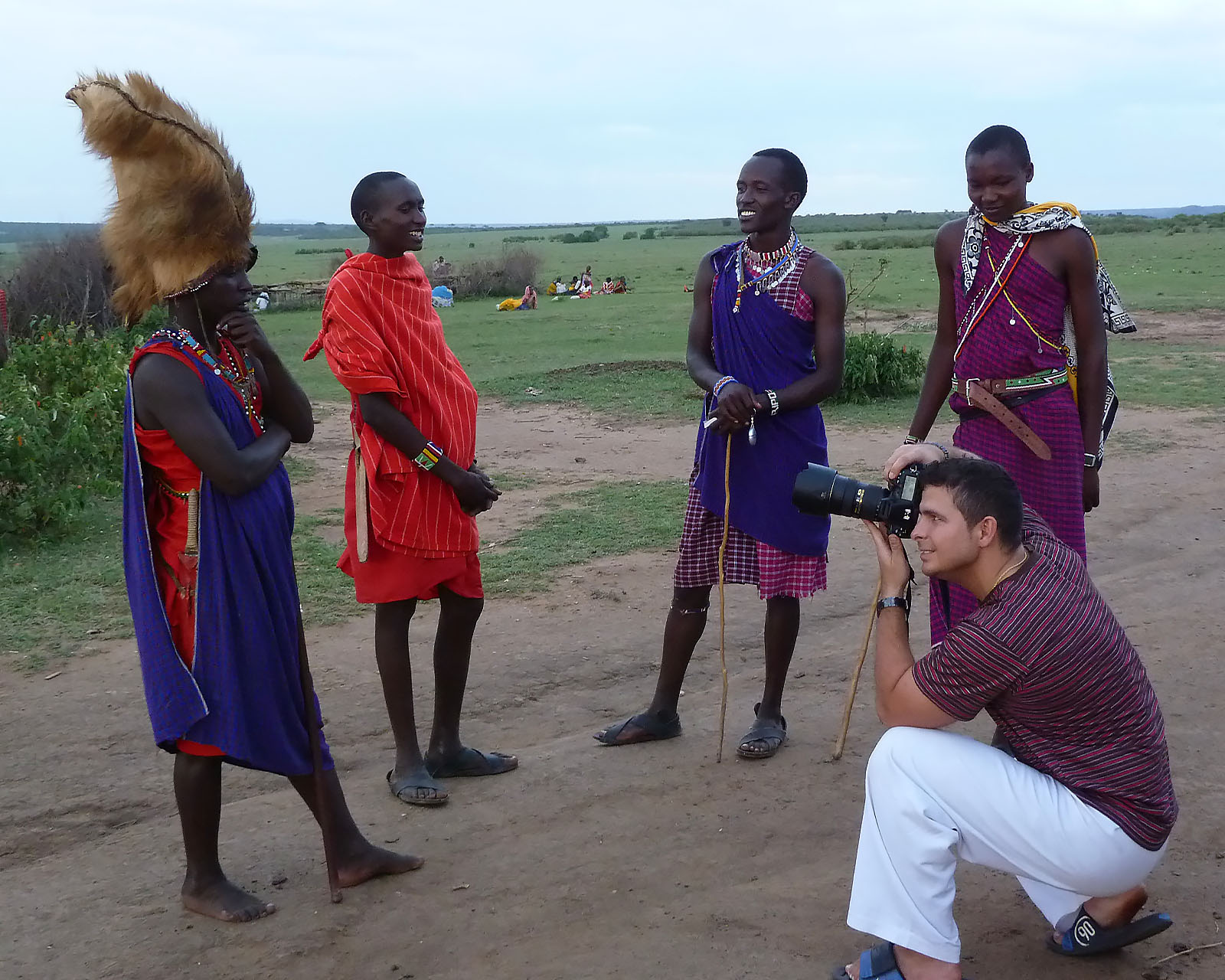
During my visit to a Maasai village near Tsavo East, four smiling observers quickly transformed one photographer and one camera into a complete creative team.
A visit to a Maasai village near Tsavo East became one of the most personal photographic moments of my journey through Kenya. Instead of observing the meeting from behind the window of a safari vehicle, I found myself kneeling on the ground with my camera while four Maasai men gathered around me. Judging by their expressions, everyone had an opinion about the photograph—although I was still the only person carrying the camera.
The picture captures the moment from the opposite side of my usual travel photography. I am not hidden behind the lens but clearly visible in front of it, concentrating on the portrait I was about to take. The four men appear relaxed and amused, watching both me and the photographic process. Their smiles turned what could have been a formal portrait session into a spontaneous and friendly exchange.
Their clothing immediately stood out against the open Kenyan landscape. The red, blue and purple shukas, decorative beadwork, belts, walking sticks and ceremonial elements created a striking combination of colour and texture. These details were visually powerful, but I did not want to treat them merely as exotic decoration. They belonged to the people standing in front of me and represented a living culture rather than a costume prepared only for my camera.
The Maasai are one of the best-known communities of East Africa, traditionally associated with pastoral life and cattle herding across southern Kenya and northern Tanzania. Their culture has developed through a close relationship with land, livestock, family and community. During my short visit, I could only see a small part of that much larger story, but even this brief encounter showed me how limited a photograph can be—and how valuable it becomes when it preserves a genuine human connection.
What I remember most from the Maasai village near Tsavo East is not a list of facts or a staged presentation. I remember the atmosphere around this particular moment: curiosity on both sides, laughter, changing positions and several people trying to help create the final composition. Photography became a shared activity. I may have been deciding about focus and framing, but the men in front of me were very much involved in shaping the scene.
That is why the title “One Camera, Four Art Directors” fits the photograph so well. Every photographer knows that one camera can attract many opinions. A slight movement to the left, a different angle, another pose or perhaps an entirely new idea—the creative department expanded quickly. Fortunately, the meeting included far more smiles than serious instructions, and the camera remained under my control for at least most of the session.
The surrounding landscape also matters to me. Behind us stretched an open green plain, with low vegetation, distant groups of people and an enormous African sky. It placed the meeting within the wider environment of southeastern Kenya, close to the Tsavo ecosystem that defined this part of my journey. After photographing wildlife across the park, this visit added a human dimension to my experience of the region.
Photographing people requires a different kind of attention than photographing animals or landscapes. Technical settings remain important, but the success of the image depends just as much on trust, timing and the atmosphere between the person holding the camera and the person standing in front of it. A perfect exposure cannot replace a natural expression, and the most expensive lens cannot create a genuine smile.
This moment reminded me to lower the camera occasionally and participate in the meeting rather than simply document it. The photographs mattered, but so did the conversations, gestures and shared laughter between each frame. I did not want to leave with only colourful portraits. I wanted to remember the people who helped create them and the friendly energy surrounding the entire encounter.
When I look at this photograph today, I see more than myself preparing another shot. I see the reversal of the usual roles: the photographer became part of the picture, while the people I intended to photograph became observers, critics and, at least for a moment, my creative team.
My visit to a Maasai village near Tsavo East was brief, and I would never claim that such a short encounter gave me a complete understanding of Maasai life. It did, however, give me an authentic memory of meeting people through photography. Four art directors, one photographer and one camera turned out to be exactly the right team.
- Date
- 2026-01-01