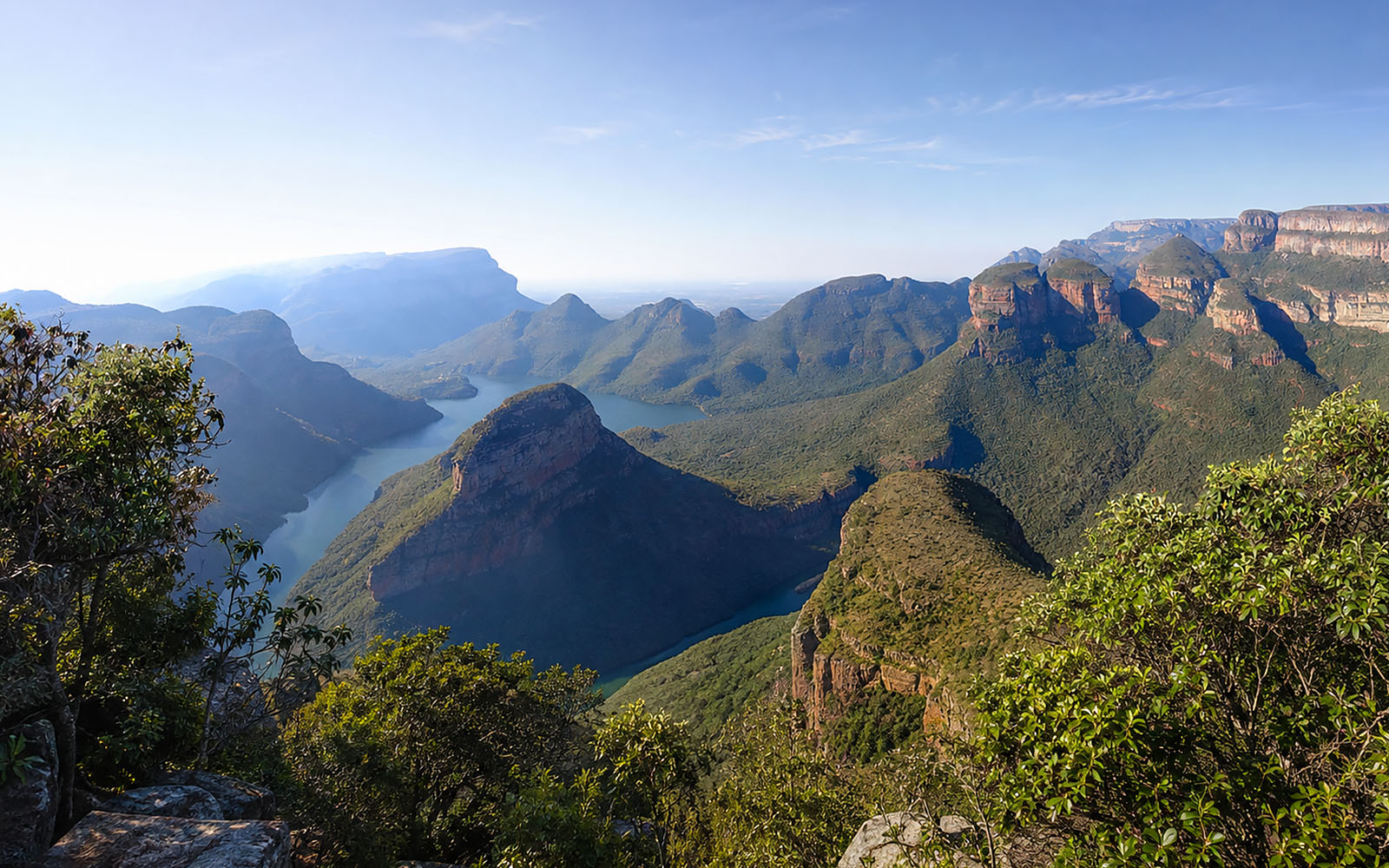
Blyde River Canyon South Africa stretches beyond the limits of my camera, revealing the Three Rondavels, Blydepoort Dam and the green cliffs of Mpumalanga.
Blyde River Canyon South Africa is one of those places where even the widest camera lens seems unable to contain the entire landscape. I took this photograph from the area of the Three Rondavels Viewpoint on Mpumalanga’s famous Panorama Route. In front of me, forested slopes, monumental rock formations and the winding water of the Blydepoort Dam created a view that appeared to continue far beyond the edges of my frame. That feeling inspired the title “Nature Has No Panorama Mode.”
Standing above the canyon, I immediately understood that this was not a landscape I could capture with a single press of the shutter. Every part of the view demanded attention. The water curved between the mountains like a narrow blue ribbon, the steep cliffs revealed layers of warm red and brown rock, and the green vegetation softened the enormous scale of the surrounding walls. The further I looked, the more details appeared.
On the right side of the photograph are the distinctive rock formations known as the Three Rondavels. Their rounded peaks resemble traditional southern African houses with circular walls and conical roofs, which is how the formations received their name. Seen from across the canyon, they look less like individual mountains and more like enormous natural sculptures placed above the valley.
Below them lies the Blydepoort Dam, also known as the Blyderivierspoort Dam. From the viewpoint, the reservoir appears calm and almost delicate, although it is surrounded by cliffs and slopes of impressive scale. Its winding shape helps reveal the depth and direction of the canyon. Without the water, it would be much harder to understand how far the landscape extends into the distance.
Blyde River Canyon is also known as Motlatse Canyon and forms part of the Greater Drakensberg escarpment. What separates it visually from many famous canyons is the abundance of vegetation covering its walls and valleys. Instead of a predominantly dry and rocky landscape, I saw deep greens mixed with exposed layers of stone. The contrast made the canyon feel both monumental and alive.
The official tourism information describes the canyon as approximately 26 kilometres long and around 800 metres deep on average. Numbers help explain its size, but they do not fully communicate the experience of standing at the edge and seeing one ridge disappear behind another. The photograph records only one direction and one moment, while the actual landscape surrounds the viewer with space, distance and changing light.
When I composed this frame, I used the vegetation and rocks in the foreground to create a natural entrance into the scene. Beyond them, the water leads the eye through the valley, while the Three Rondavels and the layered escarpment provide the scale. I wanted the photograph to feel deep rather than flat, as if the viewer could visually travel from the nearest leaves to the most distant blue horizon.
The clear sky gave the photograph an almost unlimited sense of space. Strong sunlight illuminated the upper parts of the mountains while the deeper sections of the canyon remained in shadow. This difference between light and darkness revealed the shape of the terrain and gave every ridge its own depth. It also reminded me how quickly the appearance of a landscape can change as the sun moves across it.
The Blyde River Canyon South Africa panorama was one of the most impressive views I encountered while travelling through Mpumalanga. The Panorama Route is appropriately named because it connects a series of viewpoints, waterfalls and geological formations, including God’s Window, Bourke’s Luck Potholes and the Three Rondavels. However, this particular view stayed with me because it brought so many elements together in a single scene: mountains, water, forest, exposed rock and an almost endless horizon.
As a photographer, I often try to organise the world inside a rectangular frame. I choose what should remain visible and what must be left outside. At Blyde River Canyon, nature seemed completely uninterested in those limitations. The landscape continued in every direction, and every small adjustment of the camera revealed another possible composition.
That is why “Nature Has No Panorama Mode” feels like the right title for this image. A camera can create a panorama by combining several frames, but the real experience cannot be reduced to image dimensions. It includes the height of the viewpoint, the distance to the opposite cliffs, the silence above the valley and the sense of standing in front of something shaped over a timescale far greater than my own.
This photograph is my attempt to preserve that moment. It cannot contain the entire canyon, but it records the way the view opened before me: green, immense and layered all the way to the horizon. Sometimes photography is not about fitting everything into the frame. Sometimes it is simply about accepting that nature will always be bigger than the photograph.- Date
- 2026-01-01